Compound Interest: Grow Savings by 15% Annually in 2026

Anúncios
Compound interest is the powerful financial principle where earnings from your initial investment, plus accumulated interest, generate further earnings, accelerating wealth growth significantly.
Anúncios
Are you ready to truly understand the secret behind long-term wealth accumulation? Understanding Compound Interest: How to Grow Your Savings by 15% Annually in 2026 is not just a financial concept; it’s a fundamental force that can transform your financial future. This guide will demystify how your money can work harder for you, building on itself year after year.
Anúncios
The Core Principle of Compound Interest Explained
Compound interest is often hailed as the ‘eighth wonder of the world’ for good reason. It’s the process where the interest you earn on your initial investment also earns interest. This creates a snowball effect, where your money grows not just on your principal, but also on the accumulated interest from previous periods. It’s a powerful engine for wealth creation, especially when given enough time.
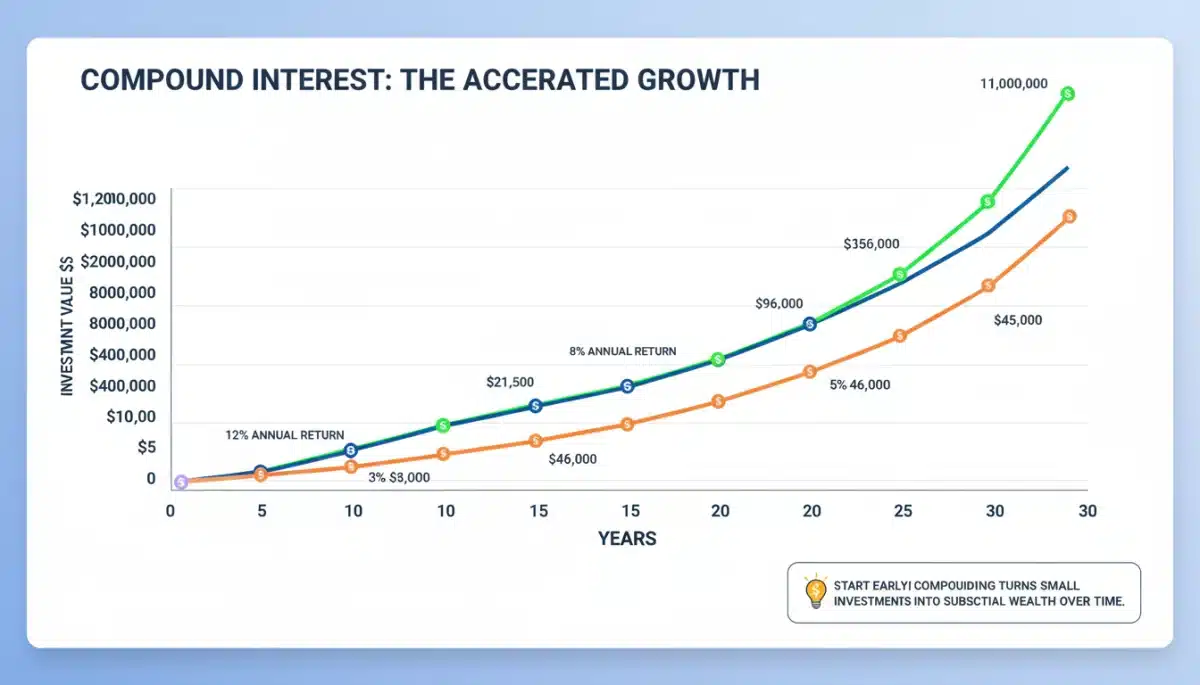
Unlike simple interest, which is calculated only on the principal amount, compound interest allows your earnings to compound over time, leading to exponential growth. This distinction is crucial for anyone looking to maximize their savings and investments. The longer your money is invested, the more significant the impact of compounding becomes, turning modest initial contributions into substantial sums.
How Compound Interest Differs from Simple Interest
Understanding the fundamental difference between simple and compound interest is the first step towards harnessing its power. Simple interest is straightforward; it’s calculated only on the original principal amount. Compound interest, however, builds upon itself, adding interest to both the principal and previously earned interest.
- Simple Interest: Calculated solely on the initial principal.
- Compound Interest: Calculated on the principal plus accumulated interest.
- Growth Trajectory: Simple interest grows linearly; compound interest grows exponentially.
- Long-Term Impact: Compound interest significantly outperforms simple interest over extended periods.
This compounding effect means that your money starts to generate its own earnings, which then generate even more earnings. It’s a virtuous cycle that can dramatically accelerate your financial goals, making it an indispensable tool in any long-term financial strategy. The frequency of compounding—daily, monthly, quarterly, or annually—also plays a role, with more frequent compounding generally leading to greater returns.
In essence, compound interest allows your wealth to grow at an accelerating rate. It turns time into your most valuable asset when it comes to investing. By understanding this core principle, you can begin to make more informed decisions about where and how you save and invest your money, setting the stage for significant financial growth.
Setting Realistic Goals: Achieving 15% Annual Growth by 2026
Achieving a 15% annual growth rate is an ambitious but attainable goal for many investors, especially when leveraging the power of compound interest. This section explores what it takes to set and work towards such a target, emphasizing the importance of a well-defined strategy and realistic expectations.
While past performance is not indicative of future results, a 15% annual return requires a combination of smart investment choices, consistent contributions, and a clear understanding of market dynamics. It’s not about finding a magic bullet, but rather about constructing a robust portfolio designed for growth.
Components of a 15% Annual Return Strategy
To target a 15% annual return, several key components must be considered. This isn’t just about picking high-growth stocks; it involves diversification, risk management, and a long-term perspective. Understanding these elements is crucial for building a resilient investment plan.
- Diversification: Spreading investments across various asset classes (stocks, bonds, real estate, etc.) to mitigate risk.
- Growth-Oriented Investments: Allocating a portion of your portfolio to assets with higher growth potential, such as specific sectors or emerging markets.
- Regular Contributions: Consistently adding to your investments, allowing more capital to compound over time.
- Reinvestment of Earnings: Ensuring that all dividends and interest earned are reinvested back into the portfolio to maximize compounding.
Achieving such a return often involves a higher degree of risk compared to more conservative investments. Therefore, it’s essential to assess your personal risk tolerance and align your investment strategy accordingly. A well-balanced approach that combines growth opportunities with sensible risk management is key.
Setting a target of 15% annual growth by 2026 requires more than just hope; it demands a proactive and informed approach to investing. This involves continuous learning, adapting to market conditions, and a commitment to your financial plan. With compound interest working in your favor, consistent effort can lead to impressive results.
Key Investment Vehicles for Compounding Your Wealth
The choice of investment vehicles is paramount when aiming to maximize compound interest and achieve significant financial growth. Different investment types offer varying levels of risk and potential return, making it essential to select options that align with your financial goals and risk tolerance.
From traditional stocks and bonds to more modern exchange-traded funds (ETFs) and mutual funds, each vehicle presents unique opportunities for compounding. Understanding their characteristics and how they interact within a diversified portfolio is critical for success.
Exploring High-Growth Investment Options
To target a 15% annual return, it’s often necessary to consider investment vehicles that offer higher growth potential. While these may carry more risk, they also provide the opportunity for substantial compounding over time. A balanced approach often includes a mix of these with more stable assets.
- Growth Stocks: Companies expected to grow at an above-average rate compared to the market.
- ETFs (Exchange-Traded Funds): Diversified portfolios that track an index, sector, or commodity, offering broad market exposure.
- Mutual Funds: Professionally managed portfolios of stocks, bonds, or other investments, suitable for diversification.
- Real Estate Investment Trusts (REITs): Investments in income-producing real estate, offering dividends and potential capital appreciation.
Investing in these vehicles requires careful research and understanding of market trends. It’s advisable to consult with a financial advisor to tailor an investment strategy that best suits your individual circumstances and objectives. The goal is to identify assets that not only grow in value but also generate income that can be reinvested.
By strategically selecting and combining these investment vehicles, you can create a portfolio that is optimized for compounding. The key is to balance potential for high returns with an acceptable level of risk, ensuring that your financial journey is both prosperous and sustainable. Remember, consistent monitoring and adjustment are also vital for long-term success.
The Role of Time and Consistency in Compound Interest
Time is arguably the most critical factor when it comes to leveraging the power of compound interest. The longer your money has to grow, the more significant the compounding effect becomes. Starting early, even with small amounts, can lead to far greater wealth accumulation than larger contributions made later in life.
Consistency in contributions also plays a pivotal role. Regular investments, regardless of market fluctuations, ensure that you are continually adding to your principal, which then has more capital to compound. This disciplined approach smooths out market volatility and maximizes long-term returns.
Why Starting Early Matters Immensely
The concept of ‘time in the market’ versus ‘timing the market’ is particularly relevant for compound interest. The earlier you begin investing, the more time your money has to benefit from compounding, even if your initial contributions are modest. This phenomenon is often illustrated with powerful examples.
- Exponential Growth: Early investments have more compounding periods, leading to exponential growth.
- Lower Initial Capital: Less initial capital is needed to achieve significant wealth over a longer period.
- Market Volatility Mitigation: Longer investment horizons allow you to ride out short-term market downturns.
- Reduced Stress: Less pressure to make aggressive, high-risk investments later in life.
Consider two individuals: one starts investing $200 per month at age 25, and another starts $400 per month at age 35. Assuming the same annual return, the one who started earlier will likely have significantly more wealth by retirement age, thanks to the extra decade of compounding. This highlights the immense advantage of early investment.
The synergy between time and consistent contributions creates a powerful engine for wealth building. By committing to a long-term investment strategy and regularly contributing to your portfolio, you allow compound interest to work its magic, turning consistent effort into substantial financial freedom over the years.
Mitigating Risks and Diversifying Your Portfolio
While aiming for a 15% annual return is exciting, it’s equally important to understand and mitigate the inherent risks involved. No investment is without risk, and a well-thought-out strategy includes robust risk management and diversification to protect your capital and ensure sustainable growth.
Diversification, in particular, is a cornerstone of prudent investing. It involves spreading your investments across various asset classes, industries, and geographies to reduce the impact of poor performance in any single area. This approach helps to smooth out returns and reduce overall portfolio volatility.
Strategies for Effective Risk Management
Effective risk management is not about avoiding all risks, but rather about understanding and controlling them. For investors targeting higher returns, this means being aware of potential downturns and having strategies in place to navigate them without panicking or making rash decisions.
- Asset Allocation: Distributing investments among different asset classes (stocks, bonds, cash, real estate) based on your risk tolerance.
- Geographic Diversification: Investing in companies and markets across different countries to reduce country-specific risks.
- Sector Diversification: Spreading investments across various industries to avoid over-reliance on a single sector.
- Regular Rebalancing: Periodically adjusting your portfolio to maintain your desired asset allocation as market values change.
Understanding your personal risk tolerance is fundamental. Are you comfortable with significant market fluctuations for potentially higher returns, or do you prefer a more stable, albeit slower, growth path? Your answer will dictate the specific mix of assets and the level of risk you should take.
By implementing sound risk management and diversification strategies, you can build a resilient portfolio capable of weathering market storms while still pursuing your goal of a 15% annual return. It’s about finding the right balance between aggressive growth and prudent protection of your hard-earned capital, ensuring your compound interest journey remains on track.
Monitoring and Adjusting Your Investment Strategy
An investment strategy is not a static document; it’s a dynamic plan that requires continuous monitoring and occasional adjustments. The financial landscape is constantly evolving, with new opportunities and challenges emerging regularly. To maintain a 15% annual growth target, you must be prepared to adapt.
Regular review of your portfolio’s performance, along with an assessment of your financial goals and personal circumstances, is essential. This proactive approach ensures that your investments remain aligned with your objectives and that you are maximizing the potential of compound interest.
The Importance of Regular Portfolio Reviews
Consistent oversight of your investments allows you to identify underperforming assets, capitalize on new trends, and ensure your portfolio’s risk profile remains appropriate. Simply setting up an investment and forgetting it is a common mistake that can hinder long-term growth.
- Performance Tracking: Regularly checking how your investments are performing against your benchmarks and goals.
- Market Analysis: Staying informed about economic trends, industry changes, and geopolitical events that could impact your investments.
- Goal Reassessment: Ensuring your investment strategy still aligns with your current financial goals and life stages.
- Tax Efficiency: Optimizing your portfolio for tax efficiency to maximize net returns.
When reviewing your portfolio, consider both the absolute returns and the returns relative to market benchmarks. This helps you understand if your investments are truly performing well or simply moving with the broader market. Adjustments might include rebalancing your asset allocation, selling underperforming assets, or investing in new opportunities.
Being proactive in monitoring and adjusting your investment strategy is crucial for sustained success. It allows you to respond effectively to market changes, take advantage of new information, and ensure that the power of compound interest is always working optimally for your financial future. This ongoing engagement is a hallmark of successful long-term investors.
| Key Point | Brief Description |
|---|---|
| Compound Interest Power | Earnings on principal and accumulated interest, accelerating wealth growth over time. |
| 15% Growth Goal | Ambitious but achievable with strategic diversification, consistent contributions, and smart investment choices. |
| Investment Vehicles | Growth stocks, ETFs, mutual funds, and REITs are key for higher returns and compounding. |
| Risk Management | Diversification across assets and geographies, with regular rebalancing, is crucial for mitigating risks. |
Frequently Asked Questions About Compound Interest
Simple interest is calculated only on the initial principal amount, leading to linear growth. Compound interest, however, is calculated on the principal plus all accumulated interest, resulting in exponential growth over time, making it far more powerful for long-term savings.
While ambitious, a 15% annual return is achievable for investors willing to take on calculated risks and employ a diversified strategy. It typically involves investing in growth-oriented assets and requires consistent monitoring and adjustments to market conditions.
Starting early is crucial because it provides your money with more time to compound. Even small, consistent contributions made over a longer period can result in significantly larger sums compared to larger contributions started later, due to the exponential nature of compounding.
Investment vehicles like growth stocks, exchange-traded funds (ETFs), mutual funds, and Real Estate Investment Trusts (REITs) are often good choices. They offer potential for appreciation and/or income generation, which can be reinvested to maximize the compounding effect.
Diversification is extremely important. It helps mitigate risks by spreading investments across various asset classes and sectors, reducing the impact of poor performance in any single area. This strategy contributes to more stable and sustainable growth, even when targeting higher returns.
Conclusion
Harnessing the power of compound interest is not merely a theoretical exercise; it’s a practical and proven pathway to significant wealth accumulation. As we’ve explored, achieving a 15% annual growth rate by 2026 requires a clear understanding of financial principles, strategic investment choices, consistent effort, and proactive risk management. By starting early, diversifying your portfolio across suitable investment vehicles, and diligently monitoring your progress, you can truly make your money work for you, transforming your financial landscape and securing a more prosperous future.
